
What Taxes Do Retirees Pay in Pennsylvania? Social Security, 401(k)s & More

Pennsylvania levies a 3.07% flat personal income tax, but its tax rules treat retirement income differently from other sources of income.
Retirees may still face state and local taxes on income and spending outside those exclusions.
Retirement Tax Friendliness by State
Income, Social Security, pension, IRA/401(k), investment income, and sales tax treatment for retirees
Hover or tap a state to see details
Does Pennsylvania Tax 401(k) Distributions?
Learn when Pennsylvania taxes 401(k) distributions, when retirement withdrawals may be tax-free, and how early distributions are treated under PA tax rules.
See PA Tax Rules
Does Pennsylvania Tax Social Security Benefits
Pennsylvania does not tax Social Security benefits.
Social Security payments are excluded from compensation and exempt from PA personal income tax.
A retiree living on $25,000 of Social Security would pay $0 in Pennsylvania state income tax.
But federal income tax is different. Depending on your total income, some of your Social Security benefits can be taxable federally.
Are Pensions, 401(k)s, and IRAs Taxed?
Your distributions from tax-deferred accounts such as
- Traditional IRAs
- 401(k)s, etc are exempt from PA tax if received after age 59½ and not rolled over.
PA treats such retirement distributions like pension income.
| Income | Taxed by PA? | When Taxable |
|---|---|---|
| Social Security | No | — |
| Pension | Usually No | If retirement or plan requirements aren’t met |
| 401(k) | Usually No | Early distribution or non-eligible plan |
| Traditional IRA | Usually No | Before age 59½ or another qualifying event |
| Roth IRA | Usually No | Certain distributions before age 59½ |
| Early IRA/401(k) withdrawal | Possibly | Amount exceeding previously taxed contributions |
| Direct rollover | No | — |
| Taxable interest | Yes | Generally taxable as PA interest income |
Does Pennsylvania Tax Roth IRA Withdrawals?
Qualified Roth IRA and Roth 401(k) withdrawals are also not taxed by PA if they meet the usual requirements.
A Roth is considered an eligible retirement plan under PA law, so after age 59½, its distributions are not included in taxable compensation.
| Your Situation | PA Tax on Roth Withdrawal |
|---|---|
| Age 59½ or older | Generally $0 |
| Under 59½ — withdrawing your contributions | $0 |
| Under 59½ — withdrawing more than your contributions | Excess may be taxable |
| Roth earnings still inside the account | $0 |
| Rollover to another IRA | Generally $0 |
| Federal early-withdrawal exception | Doesn’t automatically make it PA tax-free |
So, if you withdrew $15,000 at age 50, and your basis was $10,000, then the $5,000 earnings would be taxed at 3.07% = $153.50.
Which States Don’t Tax 401(k) Withdrawals?
See which states don’t tax 401(k) withdrawals, including states with no income tax and states that fully or partially exempt retirement income.
See The States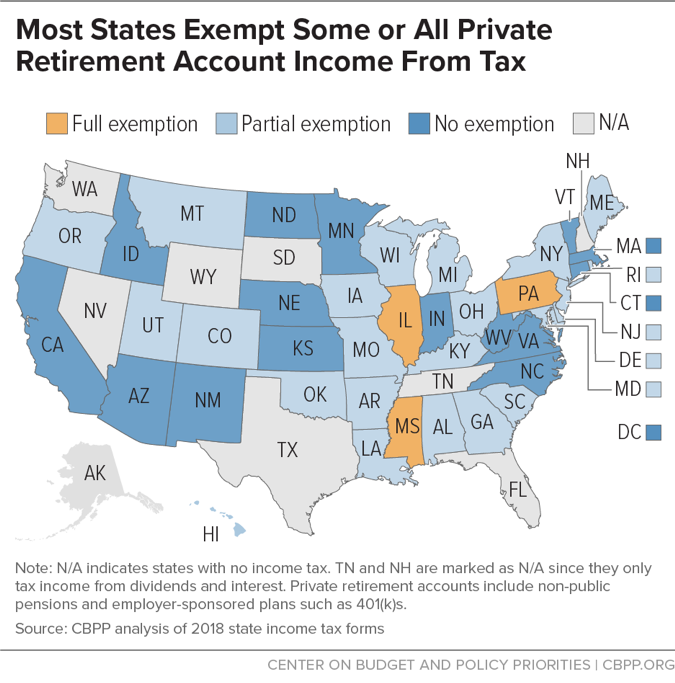
Investment Income: Interest, Dividends, Capital Gains
Pennsylvania taxes investment income at the flat 3.07% rate.
Your ordinary interest and dividend income are separate gross income classes and fully taxable under PA PIT.
Capital gains are likewise taxed at 3.07%, and Pennsylvania has no preferential capital gains rate.
| Investment Income | PA Tax Treatment | PA Rate |
|---|---|---|
| Ordinary interest | Generally taxable | 3.07% |
| Dividends | Generally taxable | 3.07% |
| Capital gains | Net taxable gains generally taxable | 3.07% |
| Mutual-fund capital-gain distributions | Generally taxable as dividend income | 3.07% |
| U.S. Treasury interest | Exempt from PA tax | 0% |
| PA state/local government interest | Exempt from PA tax | 0% |
| Interest from other states’ bonds | Generally taxable by PA | 3.07% |
Do Retirees Pay Property & Sales Taxes?
Pennsylvania offers a Property Tax/Rent Rebate program for seniors and people with disabilities.
Eligible older homeowners and renters can receive rebates of up to $1,000 on property taxes or rent paid.
| Tax | What You Pay | Note |
|---|---|---|
| Property tax | Varies locally | County, municipality & school district determine the rate |
| Sales tax | 6% | Applies to taxable purchases |
| Philadelphia | 8% total | 6% state + 2% local |
| Allegheny County | 7% total | 6% state + 1% local |
| Realty transfer tax | 1% state | Paid when real estate is transferred; local tax may also apply |
Pennsylvania also has a state sales tax rate of 6.0%, with Philadelphia at 8% and Allegheny County at 7% total.
There is no special sales tax exemption for seniors, but PA does exempt
- Most groceries (non-prepared food) and
- Clothing (usually items under $110) for everyone.
Is Military Retirement Income Taxable?
Learn how military retirement pay is taxed, including federal taxes, state exemptions, VA disability benefits, CRSC and other tax-free retirement income.
See Military Tax Rules
Pennsylvania Retirement Taxes vs. Other States
The table below compares the six states across the key tax factors that can affect retirees, including
- Retirement income
- Investment income
- Property taxes, and
- Sales taxes.
| Tax / Benefit | PA | FL | TX | NY | CA | OH |
|---|---|---|---|---|---|---|
| Social Security | Exempt | No state tax | No state tax | Exempt | Exempt | Exempt |
| IRA / 401(k) | Exempt* | No state tax | No state tax | Taxed* | Taxed | Taxed |
| Pensions | Exempt* | No state tax | No state tax | Partially exempt* | Taxed | Taxed |
| Roth IRA | Exempt* | No state tax | No state tax | Generally exempt | Generally exempt | Generally exempt |
| Investment Income | 3.07% | None | None | Up to 10.9% | Up to 13.3% | Taxed |
| Property-Tax Relief | Senior rebate | Strong | Strong | Local programs | Prop. 13 | Senior programs |
| State Sales Tax | 6.0% | 6.0% | 6.25% | 4.0% | 7.25% | 5.75% |
Overall, Florida and Texas offer the strongest advantages for retirees seeking to minimize state income taxes, while Pennsylvania is particularly attractive for retirees with substantial traditional retirement income.
Ohio and New York offer a more mixed tax picture, while California generally has the highest potential state income-tax burden on investment and retirement income.
How to Reduce Taxes in Retirement
Pennsylvania retirees can leverage PA’s tax rules to save money, for example:
- Qualified Charitable Distributions (QCDs): Donors 70½+ can direct IRA distributions to charity. This removes the amount from taxable income federally, and since PA does not tax IRA withdrawals anyway, you get a pure federal tax benefit.
- Roth conversions: Converting a traditional IRA to Roth triggers federal tax now but no PA tax.
- Asset location – municipal and U.S. bonds: Since PA taxes interest, prefer PA/US municipal bonds and Treasury bonds.
- Tax-loss harvesting: Sell losing investments to offset gains.
- Property tax/rent rebates: Ensure eligibility and timely apply for the PTRR program.
- Retain PA residency: Since PA imposes no tax on most retirement income, high-income retirees keep more by staying here.
Each strategy must fit your situation and federal tax picture.
How Long Will $200K Last In Retirement?
See how long $200,000 could last in retirement based on your spending, investment returns, inflation, Social Security and other sources of income.
See How Long It Lasts
References:





5 Comments