Cost of Setting Up 401(k) For Small Business: Fees & Breakdown

The cost of setting up a 401(k) for a small business depends on the type of plan, provider, and services included.
While some employers may face minimal upfront costs, ongoing expenses such as
- administration
- recordkeeping
- compliance, and
- employer contributions
can affect the total cost of maintaining a plan.
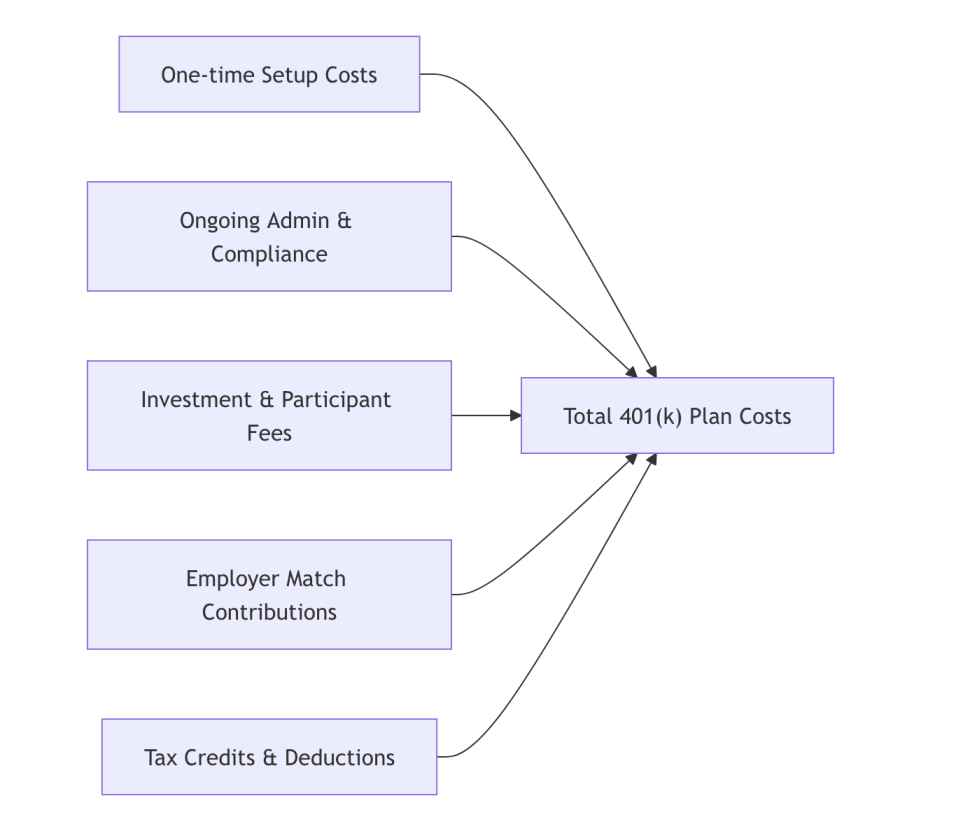
How Much Does a Small Business 401(k) Cost?
401(k) costs generally fall into three buckets:
- startup fees
- ongoing administrative fees, and
- investment fees.
Startup Fees
- Plan document preparation
- Initial plan setup and implementation
- Employee enrollment and education materials
- Payroll integration
- Administrative launch work
- Investment lineup setup and configuration
- Providers often charge these fees during onboarding, although some modern 401(k) providers waive them entirely.
Ongoing Administrative Fees
- Recordkeeping services
- Compliance and nondiscrimination testing
- Form 5500 preparation and filing
- Participant account administration
- Regulatory compliance support
- Ongoing plan management
- These are often charged as a flat fee, per-participant fee, or asset-based fee.
Investment Fees
- Mutual fund or ETF expense ratios
- Investment management fees
- Fund operating expenses
- Trading and custody costs
- Revenue-sharing arrangements (when applicable)
- Investment fees are separate from startup and administrative costs and are generally deducted directly from the investment funds rather than billed to the employer.
1. One-Time Setup Costs
Most providers charge somewhere in the $500 to $3,000 range for startup.
That can include drafting the plan document, setting up the structure, helping with employee enrollment, and connecting the plan to payroll.
| Cost Type | Typical Cost Range |
|---|---|
| Basic 401(k) plan setup | $500 – $1,000 |
| Standard small business setup | $500 – $2,000 |
| Traditional/TPA setup | $1,000 – $3,000 |
| Complex or customized plan setup | $2,000 – $3,500+ |
| Modern “flat-fee” providers | $0 – $600 |
Some providers waive the fee entirely, especially if the employer is using a bundled or pooled arrangement.
2. Ongoing administrative fees
Yes, one-time fees are expensive, but ongoing fees are where many employers feel the real cost.
| Fee Type | Typical Annual Cost Range |
|---|---|
| Recordkeeping fees | $20 – $75 per employee per year |
| Base administrative fee (flat plan fee) | $500 – $3,000 per year |
| Per-participant administration fee | $4 – $10 per employee per month |
| Compliance testing (ADP/ACP, nondiscrimination) | Often included or $300 – $1,500 per year |
| Form 5500 preparation & filing | $300 – $1,000 per year |
| Plan administration bundle (typical total) | $1,000 – $5,000 per year (small plans) |
Recordkeeping and plan administration are usually charged per participant or as a flat plan fee.
Nondiscrimination testing is a separate issue unless the plan is designed to avoid it.
For small plans, that testing and related admin work can easily add another few hundred to more than a thousand dollars per year.
3. Investment and participant fees
Investment expense ratios can be very low for index funds and much higher for actively managed funds.
| Fee Type | Typical Cost Range |
|---|---|
| Index fund expense ratios | 0.01% – 0.20% of assets annually |
| Actively managed fund expense ratios | 0.75% – 2.00% of assets annually |
| Blended investment cost (typical small plan average) | ~0.20% – 1.50% of assets annually |
| Advisory / managed account fees (optional) | 0.25% – 1.00% of assets annually |
| Recordkeeping & participant fees (often bundled) | $4 – $15 per employee per month |
| Transaction / service fees (loans, withdrawals, etc.) | $25 – $300 per transaction |
| Total all-in investment + participant cost (small business plans) | ~0.50% – 2.00% of assets annually (plus fixed per-employee fees) |
Many plans also use target-date funds, which usually sit somewhere in the middle. Some funds also include hidden revenue-sharing or 12b-1 charges.
Form 5500 Preparation
Almost all 401(k) plans must file Form 5500 each year.
If the employer hires a third party to prepare it, that service often costs roughly $250 to $750 per year.
| Cost Component | Typical Price Range | What It Includes |
|---|---|---|
| Basic Form 5500 / 5500-SF Filing (CPA or TPA add-on) | $250 – $750 | Form prep, EFAST2 filing, data entry, basic reconciliation |
| Full TPA Annual Administration Package | $1,000 – $3,000 | Filing + compliance testing + recordkeeping coordination + participant tracking |
| Bundled 401(k) Provider Admin Fee | $1,500 – $5,000 | Full admin + compliance + recordkeeping + payroll integration + filing |
| CPA-Only Filing Service | $500 – $2,000 | Form prep only from provided data; no testing or ongoing admin |
| 401(k) Audit (if required) | $8,000 – $20,000+ | Independent audit + audit report + coordination with TPA |
| Solo / Owner-Only 5500-EZ Filing | $100 – $500 | EZ form prep + simple balance reporting + basic filing support |
Solo owners with a solo 401(k) may be able to file differently if the plan stays under the asset threshold, but many businesses still prefer to have a preparer handle it.
Employer Match Costs
The employer match is not a fee, but it is part of the cost of offering the plan.
Common match formulas are:
- 50¢ on the dollar up to 6% of pay
- $1 for $1 on the first 3% of pay, then $0.50 on the next 2%
- 100% up to 4% or 6%
That said, employer contributions are generally tax-deductible, so the true after-tax cost is lower than the gross contribution amount.
Tax Credits That Reduce Costs
Tax credits can make a big difference.
The startup credit can cover up to $5,000 per year for three years, depending on employer size and other eligibility rules.
| Tax Credit | Eligibility | Amount |
|---|---|---|
| Startup Tax Credit (IRC §45E / SECURE 2.0) |
|
Up to 100% of costs (≤$5,000/yr) |
| Auto-Enrollment Credit |
|
$500/yr |
| Employer Contribution Credit (SECURE 2.0) |
|
Up to $1,000 per employee (phase-down applies) |
| Military Spouse Credit |
|
Up to $500 per spouse |
- ≤100 employees
- ≤$100,000 avg wages
- No retirement plan in last 3 years
- 1–50 employees = full credit
- 51–100 employees = reduced credit
- Employer adds automatic enrollment feature
- Default deferral ≥3% required
- Applies to new qualifying 401(k) plans
- ≤100 employees
- Employees earning < $100,000
- Contribution made by employer to eligible employees
- 1–50 employees = full credit
- 51–100 employees = reduced credit
- ≤100 employees
- Military spouse participates in plan
- Meets eligibility + vesting requirements
Cost Examples by Business Size
A tiny plan with only a handful of workers may cost only a few thousand dollars in the first year if fees are low and the employer match is modest.
As headcount grows, total costs rise because administration gets heavier and employer contributions usually rise too.
A rough way to think about it is this:
| Business Size | Typical First-Year Cost |
|---|---|
| 1–10 employees | $1,500 – $5,000 |
| 11–50 employees | $3,000 – $10,000 |
| 51–100 employees | $8,000 – $20,000+ |
These are broad examples, but they show the pattern clearly: the bigger the plan, the more the ongoing cost tends to matter.
A small-business 401(k) does cost money, but it does not have to cost a fortune.
If the plan is simple, the investments are low-cost, and the tax credits are used properly, the total price can be far more manageable.
401(k) For Small Business
Yes, SIMPLE IRAs and SEP IRAs are generally cheaper and easier to administer than 401(k) plans, but they also have lower contribution limits and fewer plan features.
Typically the employer pays plan fees, but costs may also be passed to participants through per-person charges, asset-based fees, or plan forfeitures depending on plan design.
Costs can be estimated by requesting quotes from providers and providing employee and payroll details; employers may also qualify for IRS tax credits that offset startup costs.
Failing nondiscrimination testing may require corrective refunds to highly compensated employees, while Safe Harbor 401(k) plans avoid testing in exchange for required employer contributions.
References: