Can I Retire at 62 and Get State Pension (UK Eligibility, Age & Rules)

POINTS
-
You can retire at 62 in the UK, but State Pension starts later.
-
Most private pensions can be accessed before State Pension age.
-
State Pension payments depend on your National Insurance record.
-
Many early retirees rely on savings, ISAs, or part-time income.
-
Inflation and rising costs can strain early retirement finances.
-
Careful planning helps retirement savings last longer.
Retiring at 62 is possible in the UK, but it does not align with eligibility for the State Pension.
While individuals can choose to leave the workforce at any age, access to State Pension income is determined by a separate qualifying age set by the government.
For those considering early retirement, you need to have an income between the gap of when you can stop working and when you can start receiving State Pension payments.
Source: GOV.UK
Can You Actually Retire at 62?
You can stop working at 62 in the UK, as there is no statutory retirement age. Retirement is a personal choice and is not linked to pension eligibility.
Private and workplace pensions are generally accessible from age 55 (rising to 57 from 2028), allowing retirement before SPA using accumulated pension savings.
UK Retirement Planning Calculator
Check Your Retirement Timeline, Estimate Income, And See What You Could Miss Before You Decide.
Is It Possible to Claim the State Pension at 62
State Pension cannot be claimed before State Pension age (SPA), which is currently 66. SPA is fixed by law and is independent of retirement timing.
Retiring at 62 does not trigger State Pension entitlement.
Income between 62 and SPA must come from private pensions, savings, employment, or other benefits, depending on eligibility.
Latest UK State Pension Age
State Pension age is not the same as retirement age. You can retire earlier or later and can continue working after reaching State Pension age.
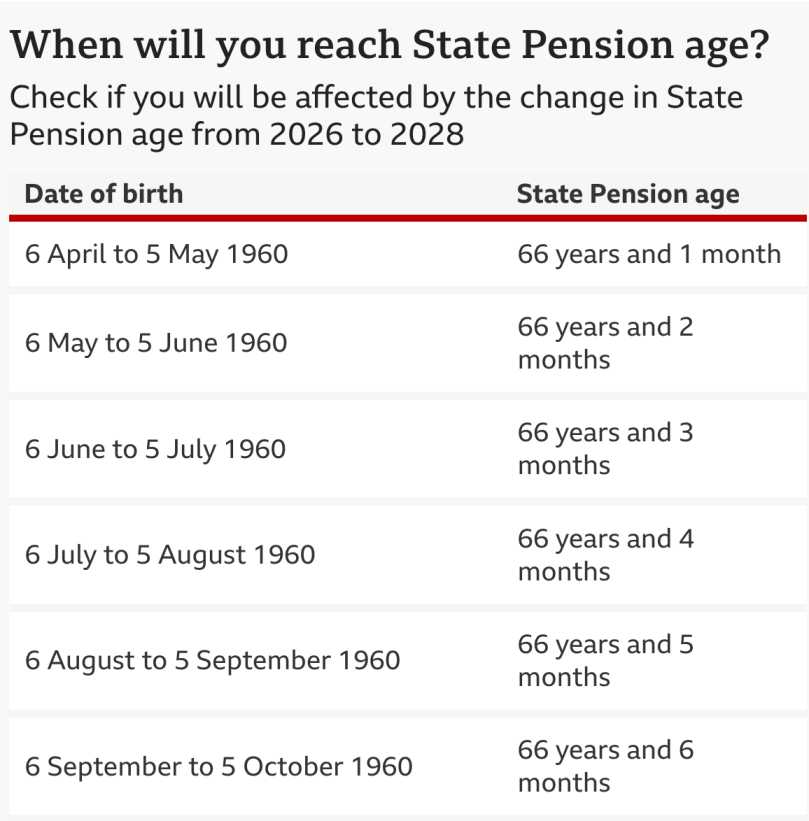
| Date of Birth | State Pension Age | When You Reach It |
|---|---|---|
| Before 6 April 1960 | 66 | Already in effect |
| 6 Apr 1960 – 5 May 1960 | 66 years, 1 month | May 2026 – Jun 2026 |
| 6 May 1960 – 5 Jun 1960 | 66 years, 2 months | Jul 2026 – Aug 2026 |
| 6 Jun 1960 – 5 Jul 1960 | 66 years, 3 months | Sep 2026 – Oct 2026 |
| 6 Jul 1960 – 5 Aug 1960 | 66 years, 4 months | Nov 2026 – Dec 2026 |
| 6 Aug 1960 – 5 Sep 1960 | 66 years, 5 months | Jan 2027 – Feb 2027 |
| 6 Sep 1960 – 5 Oct 1960 | 66 years, 6 months | Mar 2027 – Apr 2027 |
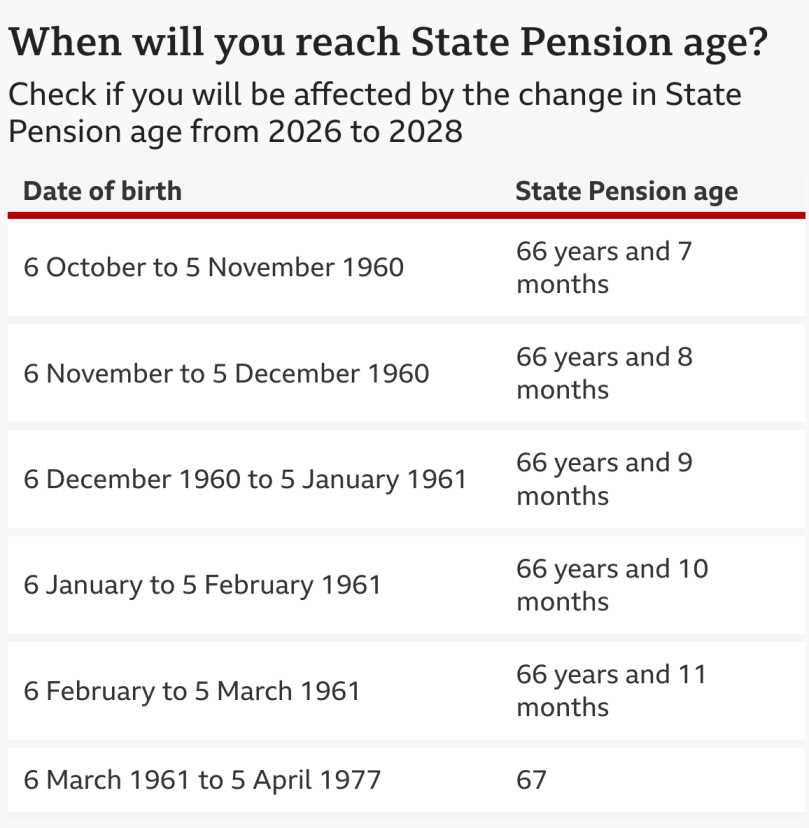
| 6 Oct 1960 – 5 Nov 1960 | 66 years, 7 months | May 2027 – Jun 2027 |
| 6 Nov 1960 – 5 Dec 1960 | 66 years, 8 months | Jul 2027 – Aug 2027 |
| 6 Dec 1960 – 5 Jan 1961 | 66 years, 9 months | Sep 2027 – Oct 2027 |
| 6 Jan 1961 – 5 Feb 1961 | 66 years, 10 months | Nov 2027 – Dec 2027 |
| 6 Feb 1961 – 5 Mar 1961 | 66 years, 11 months | Jan 2028 – Feb 2028 |
| 6 Mar 1961 – 5 Apr 1977 | 67 | From Mar 2028 onward |
| After 5 Apr 1977 | Currently planned to be 68 | Future timetable |
UK State Pension Eligibility (National Insurance Rules)
To qualify for the UK State Pension:
- Minimum: 10 qualifying years of National Insurance contributions
- Around 35 qualifying years are needed to receive the full new State Pension.
Qualifying years are earned through paid employment with NI contributions, self-employment contributions, or NI credits.
Current Full State Pension Amounts (2026/27)
| State Pension Type | Full Weekly Amount | Qualifying Years Needed |
|---|---|---|
| New State Pension (weekly) | £241.30 | 35 years (10 minimum for any pension) |
| Old Basic State Pension (weekly) | £176.45 | 30 years (men) / 25 years (women) for full pension (pre-2016 rules) |
You can combine the State Pension with other benefits after SPA (e.g., if your income is very low, you might get Pension Credit on top).
Why You Usually Cannot Claim the State Pension at 62
There are usually a few reasons for this, but mostly because eligibility is based on a fixed State Pension age, not your personal retirement age.
1. The Legal Pension Age is Higher than 62
The UK State Pension is strictly age-based. Under current law, the earliest age at which most people can claim it is 66, rising to 67 between 2026 and 2028.
Som If you are 62, you are below the legal State Pension age and therefore not eligible.
2. No Early-Access Option
Unlike some workplace or private pensions, the State Pension cannot be accessed early by choice.
The government’s guidance is explicit: “The earliest you can get your State Pension is when you reach your State Pension age.”
3. Poor Health Does Not Create an Exception
Even serious illness or disability does not allow early State Pension claims.
4. Retiring Early Does Not Trigger State Pension Payments
A person can retire from work at 62 (or younger), but retirement itself does not activate State Pension eligibility.
Someone who stops working early must wait until State Pension age before claiming.
Alternative Benefits Before Pension Age
People unable to work before State Pension age may qualify for other support instead, such as:
- Universal Credit
- Employment and Support Allowance (ESA)
- Personal Independence Payment (PIP)
- Attendance-related disability benefits
These benefits are separate from the State Pension.
Can You Retire at 62 Without a State Pension?
Yes, if you have other income to support yourself.
You can retire at 62 because the UK has no official retirement age. But if you’re below State Pension age, your State Pension payments won’t start yet.
That means you’ll need to rely on other income sources, such as:
- private or workplace pensions,
- savings or investments,
- part-time work,
- or benefits like Universal Credit or Housing Benefit.
Many people bridge the gap by drawing from private pensions, which are usually accessible from age 55.
FAQs
Explore answers to the questions we hear most, so you can plan ahead.
At what age is the State Pension paid, and why not at 62?
The State Pension is payable only from State Pension age (SPA). For most individuals, this is 66, rising to 67 and 68 for younger cohorts. It cannot be accessed at 62 because eligibility is determined by statute rather than retirement age.
Can I keep working while taking my private pension?
Yes. Defined contribution pensions can generally be accessed from age 55 (rising to 57 from 2028), and employment may continue. Pension withdrawals and earnings can be received simultaneously, subject to tax rules.
Will retiring at 62 reduce my State Pension?
Retiring at 62 stops further National Insurance (NI) contributions. The State Pension is based on NI qualifying years, with up to 35 years typically required for the full amount. Fewer qualifying years may reduce entitlement unless voluntary contributions are made.
Are any benefits available between 62 and State Pension age?
Means-tested benefits such as Universal Credit or Housing Benefit may be available before SPA, depending on income and circumstances. Pensioner-specific benefits, including Pension Credit, apply only from State Pension age.
Should I defer my State Pension to increase it?
State Pension can be deferred after reaching SPA. Deferral increases entitlement by approximately 1% for every 9 weeks deferred (around 5.8% per year). The increase is applied when payments begin and is permanent.