
Is Inheritance Marital Property in Ohio? What Happens in Divorce

POINTS
-
In Ohio, inheritances are generally considered separate property.
-
An inheritance can become marital property if it is commingled with marital assets.
-
Keeping inherited assets in separate accounts helps preserve their status.
-
Clear records are essential to prove an inheritance is separate property.
-
Ohio courts use tracing to determine whether inherited assets remain separate.
-
Careful financial planning can help protect an inheritance during divorce.
Ohio law requires courts to identify marital property and separate property before dividing assets in a divorce.
An inheritance is one category of property addressed under those rules, alongside assets acquired during the marriage.
The legal treatment of inherited property is part of Ohio’s property division framework.
Is an Inheritance Actually Yours in an Ohio Divorce?
Yes, an inheritance is generally considered yours alone in an Ohio divorce if it remains separate property.
May Stay Separate Property
- Inherited by only one spouse
- Kept separate from marital assets
- Traceable as inherited property
- Not converted into joint property
- Not mixed with marital funds
- Not increased through the other spouse’s labor or marital contributions
May Become Marital Property
- Placed into a joint account
- Used to buy jointly owned property
- Marital funds or efforts increase its value
Could You Get Ohio’s $200 Retirement Tax Credit?
See who qualifies, which retirement income counts, and how the Ohio credit works.

When Is an Inheritance Separate Property in Ohio?
Ohio’s equitable-distribution statute lists inheritances explicitly among separate property categories alongside
- Inheritance received during marriage
- Property acquired before marriage
- Passive income from separate property
- Appreciation of separate property
- Property acquired after legal separation
- Property excluded by a valid prenuptial agreement
- Property excluded by a valid postnuptial agreement
- Compensation for personal injury (with exceptions)
- Gifts given only to one spouse after marriage
Everything else acquired during the marriage, by contrast, generally counts as marital property, income and retirement growth included.
How Courts Actually Determine This?
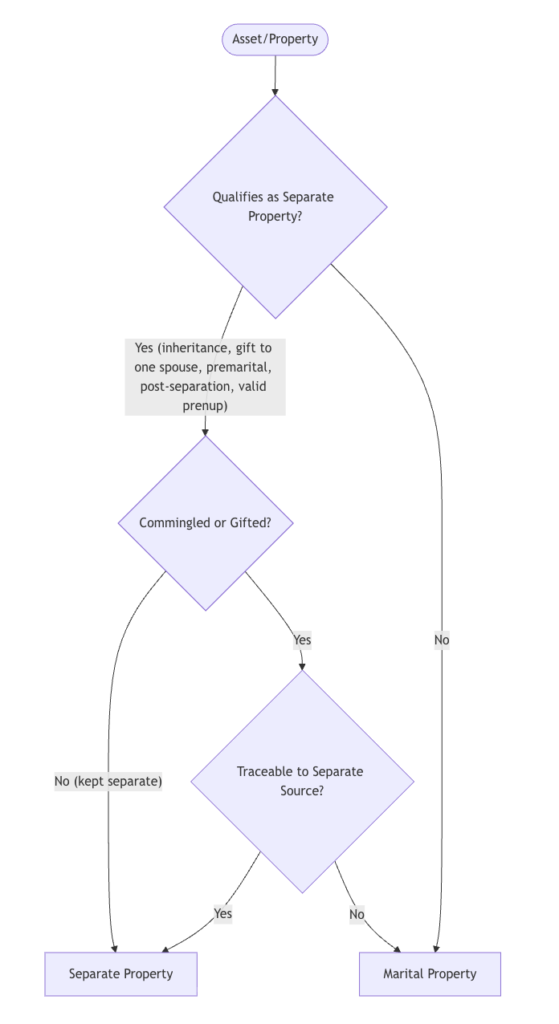
In any Ohio divorce, the court’s first task is classification.
Sorting every asset into separate or marital before dividing anything.
Critically, the burden of proof sits with the inheriting spouse, not their partner.
| Step | Key Question | Ohio Rule |
|---|---|---|
| 1 Classify Property | Is it marital or separate? | Inheritance received during marriage is generally separate property. |
| 2 Prove Separate Status | Who must prove it? | The spouse claiming separate property must prove and trace it. |
| 3 Trace Funds | Can the inheritance still be identified? | Commingling does not destroy separate status if the funds remain traceable. |
| 4 Handle Commingling | Was the inheritance mixed beyond identification? | If tracing fails, the property may be treated as marital. |
| 5 Divide Property | What gets divided? | Marital property is divided equitably; separate property generally goes back to its owner. |
| 6 Consider Appreciation | Did the asset grow in value? | Passive appreciation of separate property may remain separate; marital contributions may create a marital interest. |
How Different Asset Types Are Treated?
Inherited assets are generally protected when their original source and ownership remain clear.
| Asset Type | Usually Separate (if preserved) | How Marital Claims Can Arise |
|---|---|---|
| Cash / Bank Accounts | Inheritance kept in a spouse-only account with clear records. | Joint account deposits or spending that makes funds untraceable. |
| Real Estate | Inherited property kept in one spouse’s name with no marital contributions. | Joint title, marital mortgage payments, or improvements creating a marital interest. |
| Retirement Funds (IRA / 401k) | Inherited account kept intact; inherited principal and passive growth remain separate. | Mixing with marital funds, withdrawals for marital purposes, or unclear transfers. |
| Life Insurance | Proceeds received individually and kept separate. | Use for joint obligations or mixing with marital assets. |
| Trust Distributions | Individual distributions supported by trust documents. | Mingling funds, transfers between spouses, or shared ownership/control. |
| Business Interest | Inherited business interest maintained separately. | Marital labor, contributions, or spouse added as owner creates a marital claim. |
Your documentation, separation, and careful handling are critical.
If you can clearly show where the asset came from and how it was handled, you are in a much stronger position if the issue is later questioned.
How to Protect an Inheritance in Ohio?
1. Prenuptial/Postnuptial Agreements
A valid nuptial agreement can explicitly declare the inheritance to be separate property.
Prenups can designate separate assets.
Such agreements should clearly identify the inherited asset or its source.
2. Dedicated Accounts and Titling
You can deposit inherited cash into an account solely in your name.
Do not commingle with marital accounts.
So, when purchasing a property, title it only in the inheriting spouse’s name.
3. Avoid Using Inheritance for Marital Expenses
If possible, I recommend refraining from using inherited funds for routine family expenses, mortgage, or lifestyle, even if you plan to pay them back.
Any such use raises tracing issues. If you do use inheritance for something marital, you need to keep precise records so that portion can be traced later.
4. Maintain Records of Source and Transactions
Next, keep the inheritance documentation such as
- Wills
- Probate records
- Trust documents
- Account statements showing the inheritance deposit.
You need to maintain a paper trail of any transactions involving the asset to preserve separate property.
Collect bank statements, closing documents, receipts, etc anything that can show the original source and uses of the inheritance.
5. Trusts
Try placing inheritance in a trust that benefits only the inheriting spouse with clear separation provisions.
An irrevocable trust can shield inherited assets from division.
But courts scrutinize trusts: a trust where the spouse is not in full control is more likely to be separate, but one where they have discretion could be deemed accessible marital funds.
6. Separate Investments (Stocks, IRA & Bonds)
If investing inherited funds, use the inheritor’s separate accounts.
Don’t jointly co-sign loans with marital funds without clear agreements.
7. Consult an Attorney Early
As soon as you receive an inheritance, you need to talk to a family law attorney about strategies.
Some attorneys advise even simple steps like labeling checks or savings bonds clearly in the inheritor’s name.
Inheritance and Separate Property FAQs
Not usually. Combining inherited funds with marital assets can make them harder to trace and may cause them to be treated as marital property.
The inherited portion may remain separate if it can be clearly traced. Keep records showing the source and amount of inherited funds used.
Yes, generally. Inherited stock usually remains separate if kept separate and not mixed with marital assets.
Generally, yes, if the trust benefits only you and the funds remain separate. Mixing distributions with marital funds may create tracing issues.
An inheritance received after separation or during divorce may still be separate property, depending on state law and timing.
Generally, no. Inheritance is usually separate property unless it is commingled, cannot be traced, or is voluntarily shared.
Yes. Courts may consider inherited assets or income when determining support obligations, even if the inheritance itself is not divided.
Generally, yes. Gifts and inheritances received by one spouse are typically treated as separate property if properly maintained.
Usually not. Courts rely on documentation, account records, titles, and other evidence to determine whether property remains separate.
Keep records showing the source and use of inherited assets for as long as they may be needed, especially in case of divorce or property disputes.
References:






One Comment